
Interview with Abdulrahman Akintoye (AAA)
By Aaron Thompson and Kenny Olajide ·
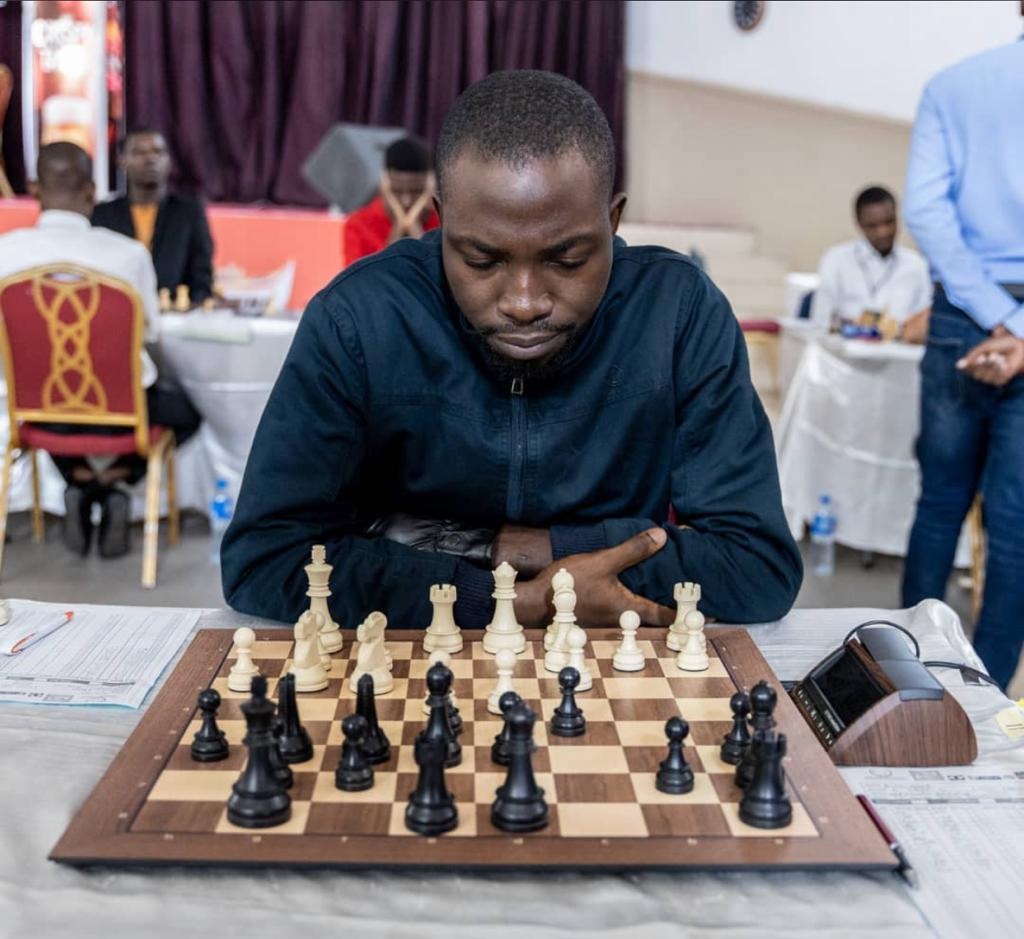
Beyond the finely carved pieces and 64 squares on the chessboard is a rare static energy brewing for chaotic flames. This stasis switches immediately when chess players arrive at the chessboard, and with one move, chaos, motion, depth, fear, confidence, and struggle emerge. We may call these human elements different names, but if we are being honest, only one word captures much of what happens on the chessboard: psychology. And that’s our scope at CFCP: to look beyond the pieces and the moves, and into the human minds behind the game.
Today we are with one of Nigeria’s most influential chess personalities, none other than the man they call Triple A, Abdurahman Akintoye, Nigeria’s top chess player for over 2 years now.
Let’s meet you.
For those who don’t know me, I have been Nigeria’s highest-ranked player since 2024. I won the West African Chess Championships in Liberia in 2024, and in 2025, I won it again when it was hosted in Lagos.
Beyond playing professionally, I also do some underground coaching work, and some of my students have had great successes, but the most prominent of them is Chiamaka Michelle Nwankwo, who, under my tutelage, has become Nigeria’s youngest WFM at only 12 years old. She also won the U-12 African Chess Championship in 2025.
So far, so good. I have coached over a hundred students under my Chess academy, The Moving Train Chess Academy in Nigeria. Recently, I have also won some tournaments, but I mustn’t brag.
Many people know you as a very strong player, but not many know the groundwork you have done as a mentor to others. More broadly, how has chess impacted your life?
Chess has impacted my life in many ways. I fell in love with chess at a time when I was about to leave secondary school. The first thing I liked about chess was that it convinced me that I could do well in Mathematics, but it was too late at the time because I was always afraid of Maths, and that’s why I opted for the Arts, where I didn’t need to do too much Maths, and I now wanted to become a Lawyer.
Chess convinced me that I could sit and think thoroughly to find solutions. When I brought this into mathematics, it was striking to see that the same way I solved chess problems was transferable to mathematics, and hence my fear of mathematics slowly began to diminish.
Chess also helped my time management. The first time I saw people playing Blitz chess, I thought they were wizards and that it was totally impossible. Good players adapt; if a good player has 4 hours to think, they’d utilize it; if you give the same player less time, they still do great. This really helped me manage my time, specifically in writing some exams, understanding that this is the time I have and I must use it judiciously.
More broadly speaking, I have made a lot of money from chess, if I’m being honest. Also, chess has given me a deeper framework /tools for analysing things/situations, and maybe that’s why I like chess even more. I already like debates, philosophy, and thinking deeply in general, and chess traverses finely and intersects with these things. Chess has sharpened my thinking, and that’s what I have gotten the most from chess.
How does your personality impact your chess play?
Well, I’m known as somewhat of an insane, aggressive player, and I don't think this is completely true when I look at my games. I play quite sharp and direct, yet simple at the same time. I think I’m a direct kinda guy; I like clear ideas and go try to execute.
Also, I like to be deep; I like to understand things at the foundational level, and this has helped me become a stronger player. So I’d say my style is positionally aggressive, if there’s such a thing.
I like to play aggressively, but the thing is, I quickly realized, of course, that you cannot beat very strong players by just being utterly aggressive. So I had to tone it down a bit, acquire some positional advantages first of all before going all out on the attack; we can say I like to attack. And so because I like to attack, I had to understand that I had to be more subtle. Even though attacking is what I want, I have to somewhat pretend as if I care about other things to get my opponent to weaken some squares, and then I can try to attack.
We’ve seen how chess can become a space where people who may feel constrained or unable to fully express themselves can find a powerful outlet for their emotions and aggression. Would you describe yourself as a disciplined attacker?
No, but it wasn't by design, to be honest. It was by experience. Because, you know, I'm always evaluating.
I'm always learning, and I think that my real talent is that I keep learning. I quickly realized, when playing good players, that just playing crazy attacks won’t work. Of course, it will work when you play weak players or people who don't really understand chess. But when you play good players, they are so positionally sound, and they punish reckless attacks clinically. So, I quickly understood that, okay, we cannot just go crazy all the time. There has to be a method to the madness, you know, so to speak.
Is there a particular experience as a chess player that made you more disciplined? Or that moment where you hit a wall and then decided to up your game.
Well, there was one particular incident that I recall, which was at an All-Africa Games trial. It was supposed to be something of a formality where the six best players were to go into the training camp, but only seven players were invited, or maybe nine. Basically, they invited one more person than the number of players needed. Now, at that point, I already thought that I was a very good player. Okay. This was supposed to be easy for me. And you can imagine fighting for a place as one of the six of the seven players, and I ended up being the only person who lost out.
I came last.
That experience, it was very tough for me to accept, you know. It was very tough because I'm already, you know, a good player; that's why I was invited in the first place. And so for it to be that I was the only one who could not survive. That experience was very painful; it really forced me to re-evaluate everything I was doing.
You wear both hats as a player and a chess coach. How do you get your students who've got real potential but aren’t putting in enough work, but hope to get to the next level? What would you tell that student?
Well, I mean, it depends on the particular circumstances of this player.
But generally, what I like to do is ask them what they want to achieve, and why they want to achieve it. So usually, my students are people who are maybe doing well and want to get to the next level. They want to become an IM, they want to become titled, and things like that.
It's okay to have this lofty goal, but I ask them what they think will be required to achieve their goals. And often, they severely underestimate what will be necessary to become very strong. They think, oh, just a few tournaments here and there.
They study a few hours a week. If you really think that's sufficient to become titled. So I would tell them that, look, if you really want to get to the next level, you cannot get to the next level by being like every other person; it doesn't work.
If there's a tournament that has 300 people playing, and you see me go to that tournament and win the tournament, you must understand that if I were like every other person, I could not win the tournament. So you have to understand that something has to be different about how you are thinking about the game, about how you are preparing for the game, about how you approach the game.
And you must not feel strange about being different. In fact, being different is something you should wear like a badge of honour, because you're different. So, when I'm making some types of demands of organizers, or I'm saying that I only want to play chess in certain conditions, some people may not understand that. They may think that's strange, but I understand that I'm different; I hold myself to a different standard. So if I decide that I'm going to play in a tournament, I'm going to play with everything I have. I'm going to prepare.
So this is the most important thing: Not being afraid of being different.
And in terms of what the value of chess is, I think the most important thing for me is that chess has given me a lot of clarity. It is a tool that can really help sharpen your thinking.
Because many people are in love with complexity for the sake of complexity. And I feel like this is the opposite of what chess teaches. So we shouldn't like complexity just because we want to sound complex, or we want to appear interesting.
Chess is not like that. There are many times when I show a lot of my games to my students where I won a game against a very strong player by using simple ideas. People have the wrong notion that to be strong, you must always be thinking complex things.
It's not true; many games I won were because I had a simple idea, but I understood the idea so deeply, so comprehensively, that I was able to continue using the same simple idea to squeeze my opponent. And then I just have him in a vice-like grip, and he can't escape. And that's it. This small weakness. I'm going to make a big deal out of this small weakness. So clarity would be my answer to that question.
Chess can feel intimidating for many people. So can simplifying the game actually make you a better player?
It's absolutely true. And it's how I approach the game. And if you don't understand something on a deep level, that is, on a simple level, it's difficult for you to improve consistently. Because it means that your foundations are shaky, it's easy for you to get confused, but if you understand at a very basic level what chess is about, what you are trying to do, what you are trying to accomplish, then an elaborate story can be built around that foundation.
So when I'm trying to execute an idea on the chessboard, and my opponent prevents it, I understand what's happening. So he's preventing it like this; now, I can try some other idea to achieve the same objective, but maybe in a slightly different way.
But it's still connected to the simple idea that I started with. You know, many times something may look ridiculously complicated, but intricately, it’s simple.
I guarantee you that if you were to ask some of the greats in different fields, not only in chess, you’d see that in their own minds, it's not as complex as you are thinking. Because they see what is happening very clearly. They understand exactly what is going on.
And the moment you see something very clearly, it starts becoming not as intimidating.
Yeah, it's like you're able to take the game of chess and make it attainable. It's like you make it something that can be observed in its entirety by kind of bringing it down to a very simple idea.
Switching gears slightly to come back to you as a player here. It’s a bit of a cliché question. What is the proudest moment of your career?
I think the proudest moment of my career so far was winning the West African Championship in Lagos in 2025. I think that was because all of the best players in West Africa were present. You see, I had won the same tournament in Liberia the year before, but a few international masters could not make it to the event. So there was this idea that because the stronger players were not playing, it was easy for me to win it.
And I won with some ridiculous score, maybe 8.5 or something. Something ridiculous.
So now, the year after that, all of the strongest players were playing. Mariano Ortega was there, IM Odion was there, all the strong players. Tennyson, Calistus, Rotimi – basically, all these bad guys were there.
To repeat the feat, and in a much stronger field, was a proud moment for me. I also saw that some of the doubters began to accept that, okay, this guy is that good. So yeah, that was a very proud moment for me.
Who are some chess players that inspire you?
Well, the first person that comes to mind is Vasyl Ivanchuk. I really like Vasyl Ivanchuk. Mainly because of his dedication and love of chess. I feel like that's something I share with him. Look, I love chess; if I didn't, I would not spend so much time learning, you know, playing and teaching.
I also love Mikhail Tal, and of course, Magnus, who is an inspiration. Yeah, I still think that there's a lot that I can do, you know, competitively. So, I want to be one of the greats.
Of course, in Africa, I like Amin Bassem, the strongest player in all of Africa; he’s a six- or seven-time African champion, something like that. Incredible guy, and quite a very simple fellow; I've met him a few times.
In Nigeria, I looked up to, and I learnt a lot from Adebayo Adeboyega; I don't know if you know this person. We call him Dabee. I went to his house sometime in the past, and I was playing against him, and he would make fun of me and beat me, but this was part of my learning; I learnt a lot from Dabee.
One of the most important things I learnt from him was on the day I accused him of playing boring chess, I said, "Oh, the way you play chess is not interesting. It's not, you know, aggressive”. He stopped me immediately and said, "No, he played aggressively. The only thing is that he's not playing tactically”. That changed something in the way I understood chess, because I thought attacking was simply to play aggressively for the head of the opponent’s king. It's to point your pieces at the person's king and try to checkmate the person immediately. But he said, No, with every move he makes, he's trying to win, and he considers that to be aggression. That with every move, he’s trying not to draw; he's trying to beat you. So why is it that we think only tactics constitute aggression? You can be aggressive in a positional way.
If I am gradually squeezing my opponent, is that not aggressive intent? It’s offensive, it’s dangerous. In many instances, this is even more dangerous than the guy who comes at you with daggers immediately; the slow squeezer takes away all of your escape squares; it's very aggressive. So that had a big impression on me.
Also, to be honest, I like Dabee’s carriage during tournaments; he had that presence. When he’s playing in a tournament, people are a little bit scared of him, and he shows them why they should be on the board.
So I kind of got a lot of inspiration from that. And now, I hope that people are scared when I sign up for any tournament.
Are you now the kind of player that opponents hoped they wouldn’t be paired against?
Yeah. And it's interesting because it wasn't always like that. Because I always understood that I was going to become very strong. But it wasn't always like that. Now, I feel like I am the predator; I'm the one that other people are worried about playing against.
But it wasn't always like that. I remember there was a time when I played IM Odion; I was so nervous before the game. Somehow, I got an advantage, and then somehow lost the game. Why are these guys always beating me? What's happening? What do I need to do to win? Looking back now, and seeing how far I have come, it has changed.
Now, if I'm playing, it's very different. When I enter a tournament, I feel like second place is a failure. I feel like, if I signed up for a tournament, like in the last two, three, or four years playing on home soil, every single tournament I have come first or second, and second has been my worst result. And that’s not bad, really.
I understand that that type of dominance cannot come by accident. And that's what I try to instil in my students. If you notice somebody doing well, respect it; I respect results a lot.
So, even if you think a tournament winner is not so good, for example, you look at their games, and you're not impressed. I can guarantee you that there's something about anybody who does well consistently that you can learn from. Don't despise results. Don't say, " Ah, but, you know, it's nothing”.
Anybody who gets consistent results is doing something right.
This is something a lot of chess players lose sight of. That at the end of the day, the results are all that matters; you can play a hell of a bloody game and end up losing. If you end up winning, you obviously have done something right.
In chess psychology, cognitive bias can shape how we judge a position or a player’s style, sometimes making us see certain approaches as better or more aggressive than they really are. What aspect of your own chess psychology are you currently working to improve? You don’t have to go into too much detail; we wouldn’t want your competitors getting any ideas they could exploit.
I would say, handling the pressure of being expected to win all the time. Yeah, I think that is tough because when I wasn't rated higher than my competitors, nobody had these kinds of expectations.
Now, after we played the Olympiad qualifiers, I won the event, but some people still didn't think it was a good event for me because towards the end of the event, after I had qualified, I lost a game and then drew some games, and all of a sudden, it's not such a great performance, but I won.
So this is a new level of pressure; if I'm being honest, I'm not completely used to. If I play nine games in a tournament, It's almost as if I'm expected to have 9/9 all the time. So I think that's a little bit strange.
Also, I need to improve in the area of playing much stronger players. I noticed sometimes that it's almost as if I'm happy with a draw against them.
And this is not who I am; I am a champion, I'm a fighter. But I can see that there's that sudden change in me. I participated in the Abu Dhabi Masters last year, and I noticed a little bit of that. When I had to play Grandmasters, those kinds of situations where the guys are 200 or 300 points higher than me.
Now, it's not like I'm afraid of losing; there’s just something about that setting, and I feel like, okay, I need to improve here. I need to turn up and play, and not go with the mindset of: let me just survive.
So I'm hoping that in the future I’ll be better. Of course, I've been trying to talk to myself about that, trying to motivate myself, trying to make sure that, okay, next time, when I have this opportunity, I'll try to make sure that I try to play my game, and make sure those jitters don’t get in my way.
Interviewer’s follow-up
So I'm a therapist here in the US, and a lot of times I apply therapy language to chess or like as a way of understanding this stuff.
And one of the ways that I describe that specific behavior is dysregulation. So it's like your physical body isn't regulated to meet a particular task. And I mean, this is something that people can work on and kind of work through. But it's really common, and a good friend of mine actually quit classical chess for that reason because every time he would sit down for a tournament game, every win was just kind of neutral, and every draw or a loss, even against strong upstart players, would be considered a massive failure. It really got to him.
So, I mean, it's jitters, but I also don't necessarily want to undersell it; what you're talking about is significant because I'm sure tons of top players experience the same thing, but they just don't identify it, or they just don't say it.
For sure, the truth is that if you really want to improve, you cannot run away from your weaknesses. And you have to be honest with yourself. You have to be very critical.
At the Abu Dhabi Masters, it was one game per day, so in the mornings, I would spend time preparing for the evening's games, but apart from that, I was talking to my friend because I lost my first two games when I got there.
A friend of mine had told me that if you go to this type of tournament, it's not like when you play in Nigeria; these are serious people; this is serious. She didn't mean to offend me or anything, but she had planted the seed in my mind that I was not going to be able to survive if I played real-world class opposition right? So, of course I I brushed that aside because I'm a champion. I'm not afraid to fight. And so I went specifically for that reason to try to test myself in the tournament.
Now, imagine after I get to the tournament, and I lose my first two games terribly. So all sorts of doubts; I started thinking (you know, I believe in results), maybe she's right, and I'm out of my depth. I’m here, I lost my first two games, and now I'm going to lose a lot of rating. I'll even lose my number one spot. All these kinds of thoughts were coming to my mind.
There was somebody else who sent me a message saying that I should just try to become friends with some of the Grandmasters, suggesting I have no chances; I mean, I don't think these people meant any harm. So basically, they felt all I could do in this kind of tournament was just get some contacts of some good players, because clearly, I'm not there to compete. But of course, you know, these experiences, these kinds of comments, they work me up. That's the truth. Somehow, I found some inner strength, talking to myself like, what'sgoing on? Why am I losing like this? There was a moment during the tournament where I was thinking: I’m in the wrong place. What’s going on?
Eventually, I managed to survive. I even managed to gain rating from that event.
Sometimes, a passing comment can stay with us for years, even when the person who said it has long forgotten it. How do you deal with such and stay focused on what matters?
We all have some degree of self-doubt from time to time. So it's possible that those comments latch on to something that was already in our minds.
Like am I am I actually good enough? So that question is somewhere in my mind. And maybe on some level, this is why I play chess too, to prove myself, to prove that I am who I am, or I am who I think I am. And I like to have external, verifiable evidence. Because I know that I may be deluding myself if I say, I am a very strong player, everybody can say that, right? If it’s just talk, everybody can claim to be something.
So I don't like to talk and say, " Oh, I'm this and that. I like to demonstrate. So if I'm able to demonstrate, then maybe this is true and I'm strong.
So that's why having bad results is tough for me because I'm looking for objective evidence.
And this can be objective evidence that I'm not good enough. So I think that's why those comments really stay with me. But okay, I managed to survive, and that was a very proud moment for me.
Maybe I gained two rating points or so from that event, but it was such a moral victory in my mind. It was a moral victory that, you know, I'm legit. I mean, it's kind of like it's like almost proving that person wrong, you know, it's like, hey, I did deserve to be here, and I did deserve to compete in this event.
It's been fantastic talking to you, by the way. I want to take this conversation to a bit more personal or deep place. Again, feel free to answer these questions or don't answer them to whatever degree you feel comfortable. But I think this is something that a lot of players who listen to this interview will really care to hear your perspective on. I want to ask what role someone you know – your parents or your family played in your chess career?
Well, that’s a bit of a complicated question for me to answer because my parents didn’t understand a thing about chess.
And they didn't understand for a long time why I would decide to play chess. What was the game about? What was going on? And they couldn't understand, especially when I decided to give up law practice to play chess.
That seemed completely unhinged to my Mom, especially. Because she felt like, okay, you're good at Law; you have a good degree. You know, she has some friends who are very senior lawyers. So in her mind, I was going to work with them, and that's how I was going to earn a living, and so on. So it was very strange, all of a sudden, that I chose to play chess.
But my move instilled in me the idea that whatever is worth doing is worth doing well, and that's something that has really stayed with me.
Like, you know, if you decide that you want to be a cleaner, I believe that you should try to be a very good cleaner. You should try to be a better person. I really cannot understand people who play chess and never really want to improve. I can't wrap my head around what's going on in their mind.
Because I just can't relate. If you decided that I like this activity, enough to spend considerable time on, you might as well try to become very good at it. You might as well try to become good. Like, even if you dedicate maybe 30 minutes, one hour a week, whatever, or consciously try to improve, what I think you should, you should.
Because if you have decided to do it, so even though my mom did not really, you know, support. I mean, now she doesn't mind, because she knows that I make some money playing chess. But then she didn’t understand why I would want to play chess. But I really remember that idea many times. And if you've decided to do something, do it well, do it to the best of your ability, push yourself, try to improve, consciously try to improve. And that has really helped me, you know, in my journey.
I think this also segues back, and again, not to be repetitive, but that kind of segues back into the instances of almost like proving chess, like you're proving the value of chess, because I'm guessing like there was a moment with your family where they're doubting your decision to move from law practice to professional chess.
And they're like, this venture, this interest is unproven. You know, like those moments before you became the champion. The moments before you became this tournament winner. I don't necessarily have anything to add to that, but I really appreciate you sharing that.
But I wanted to ask, what was the most difficult moment of your chess career? And what did you learn about yourself in that moment?
I've had a lot of difficult moments, but I think probably that event I was telling you about, I think that was the most difficult because it was so, it was so, so crushing.
I really felt like, you know, should I quit? Should I stop playing chess altogether? Because if they invited me, how can I not qualify? If only one person is to be eliminated.
How? I just needed to win. I think just let one game or something like that. Just one game and you qualify, and then out of many games, I couldn't win a single game. It was very strange, you know, but yeah, I think that was a more difficult moment. But you see, at the end of the day.
I see chess as a fight, not as an art, not as a science. I see chess more as a fight, and so I understood that no great fighter becomes great without taking some beating. It's just not possible, so I kind of came to terms with the fact that these are the dues I have to pay if I really want to be great; then I'm going to, from time to time, have these types of experiences. But the question is, what do I do with that experience?
Do I go and allow myself to have that same result next time? Okay, I'm glad to report that since then, such a thing has not happened to me again.
So, would you say these experiences have made you a more resilient chess player?
Definitely.
And also, there's a sense that I've already experienced the worst, so I feel like, what more can you do to me? I cannot have an experience worse than that.
I've already experienced that, and I survived it. Yeah. So now I feel like I'm not scared of any other challenge that may come my way.
You know, I myself, whether it's through Chess in Slums Africa, working with the Orchid Lekki Chess Club, I've been somewhat involved with the Nigerian chess scene for about seven years now.
But there are a lot of players who I think view a lot of African chess or Nigerian chess as kind of a vacuum. They have no idea what's going on. They have never heard of any of the strong players; they know nothing. And so I mean, I think number one, your role as a strong player really fights that mistake in their minds because you're present. You're kind of present in the world as a player.
What do you feel outsiders get wrong about Nigerian chess, or what assumptions do they make about Nigerian chess? How would you like to correct the record?
Oh well, I think the most fundamental mistake they make is that they underestimate the depth of talent that we have. So we have a lot of very gifted and talented players. Given the right support, given the right environment, the right engagement, we’d bloom
I myself, at risk of being immodest, feel like in a different environment, I would be definitely much, much stronger, because everything I have had to do, I have had to do by myself, so to speak.
Most of my learning has been by myself. Most of my preparation, by myself; most of my drive is from inside me. But chess is academic in some ways. That's the truth.
It's like saying that if you saw somebody who learnt to become a half-decent doctor by themselves, you'd be very impressed. Because you understand that this is something very technical that usually would require a lot of guidance. So if you see that people have become, you know, 2200, 2100, I really think that most of these people are exceptional people because of the circumstances within which they achieve those results.
If they had better circumstances, if they had better support, I really think that the world would be shocked at the kinds of things that some of these people can do. We have extremely, extremely gifted people.
So sometimes I feel like people outside don't fully understand that. And I even had that feeling; of course, it worked to my advantage when I played against some people in Gibraltar at the Gibraltar Chess Festival. I had that experience there when I played against some guys and won. They came to me afterwards, and it was such a surprise, and they were saying, how is it possible that you came from Nigeria and you play this well.
I mean, they were not being rude, but I could see that they were shocked; they felt like, come on, we are in the Western world, and how come you're able to play this well.
So, but if they knew anything about not only me, but a lot of the talent that we have here, I don't think they would have been surprised.
I think there is a big difference between a player who's, say, like 2400 or 2300 Elo, who comes from an environment where they've got all of the best GM coaches. They got tons of immediate money being funneled into them. They immediately have all the support. And then also, a player who needs to do it for the first time, they don't have that support system already established. They need to make those connections themselves. And also, playing in environments without as much chess. I think the scene in Nigerian chess has shifted dramatically in the last decade. But there was a time when it was much harder in Nigeria to find a tournament or much harder to get that chess community.
Yes, for sure, and also the fact is the matter is that to be able to, for example, let's say, get a high rating, which is what I have done in recent years, the only way, and the reason no one ever got to the highest rating that I got to, is that to do it, you need to be close to perfect, and the few events that exist.
So if you play five events and you have one bad event, your rating is not going to go anywhere because you lose all your rating. So basically I needed to be near perfect in like six or seven tournaments back to back. Every time you show up, you have to be perfect because there are not a lot of tournaments.
But if there were 40 tournaments, 50 tournaments a year, if you don’t do well here, you can recover in some other tournament, but this is not the case, so that makes it a lot more challenging.
So yeah, I agree, it's very different here. Many things you have to learn on your own; many things you have to realize on your own. After losing, you have to learn. Whereas many things that it took me years to learn, let's say I got good coaching, I would have learned them in a few months.
EndNotes
Yes. Well, you know, I've got to say, you know, this really covers the questions that I had for you for this interview.
Triple A, it was an incredible honor to talk to you. And you really do inspire me. And I've seen your games, and it feels like somebody is pouring gasoline on a board sometimes and lighting it on fire.
But that's the type of chess that I love to watch. I wish you the best of success. Is there any sort of last note that you want to close on?
No, not really, just to thank you. I was not sure exactly what to expect, but it's been a very nice and interesting conversation.
And I hope that your endeavors in chess psychology continue to improve and really develop this area of chess. Thank you for having me.